
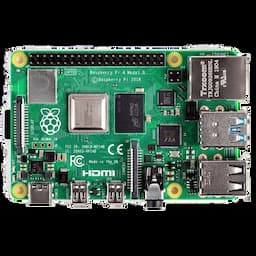
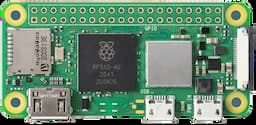
Raspberry Pi 4 vs Raspberry Pi Zero 2 W
Benchmarks, specifications, and real-world performance data
Tested by Bret Weber Last updated
Fastest
Raspberry Pi 4
5,192 MIPS 7-Zip multi-core
Best value
Raspberry Pi Zero 2 W
171 MIPS/$ at $16
Most efficient
Raspberry Pi Zero 2 W
2.3W under load
Comparison Summary
The Raspberry Pi 4 and the Raspberry Pi Zero 2 W go head to head below, with every figure taken from our own hands-on testing. If power budget matters, the Raspberry Pi Zero 2 W draws the least at 2.3W under load.
| Specification | Raspberry Pi 4 2GB RAM | Raspberry Pi Zero 2 W 512MB RAM |
|---|---|---|
| Basic Specifications | ||
| Price | ||
| RAM | 2GB | 512MB |
| SoC | ||
| Architecture | ARM | ARM |
| CPU Cores | 4 cores 4× Cortex-A72 @ 1.5GHz | 4 cores 4× Cortex-A53 @ 1.0GHz |
| Hardware Video Decode | H.264, HEVC, HEVC 10-bit Up to 4K60 | Not Tested |

Every figure above comes from hardware run in-house by Bret Weber, on the exact OS build, kernel, firmware and boot device listed here. Boards are tested to a fixed procedure so results stay comparable between them: see our testing methodology for how each benchmark is run.
CPU Performance
Processor performance across single and multi-core workloads
7-Zip Benchmark
Higher Scores are Better
UnixBench
Higher Scores are Better
PassMark CPU
Higher Scores are Better
CPU Mining (cpuminer-multi)
Higher Hashrates are Better
Geekbench 6
Higher Scores are Better
Memory Performance
Memory bandwidth and throughput benchmarks
PassMark RAM
Higher Scores are Better
Only this board has been tested so far, so there is nothing to compare against yet.
GPU Performance
Graphics rendering with OpenGL and Vulkan, plus raw Vulkan compute throughput
glmark2 (OpenGL)
Higher Scores are Better
vkmark (Vulkan)
Higher Scores are Better
AI & LLM Performance
Large Language Model inference performance
Storage Performance
Disk I/O throughput measured with FIO
fio Storage Performance - microSD
Higher Speeds are Better • Raspberry Pi 64GB (64GB microSD)
Network Performance
Ethernet and WiFi throughput measured with iPerf3
iPerf3 Network Performance
Higher Speeds are Better
Media & Video
Jellyfin transcoding and FFmpeg video decode and convert speed
Jellyfin Transcoding
Simultaneous real-time streams, more is better
Only this board has been tested so far, so there is nothing to compare against yet.
2 more scenarios and the CPU and hardware stream counts are in the benchmark table · every board ranked
Video Decoding
Software decoding on the CPU, higher fps is better
Only this board has been tested so far, so there is nothing to compare against yet.
8 more workloads and the hardware decode speeds are in the benchmark table · every board ranked
Power & Thermal
Power consumption at idle and under various workloads
Power Consumption
Lower is "Better"
Cooling & Thermal Testing
Add One More Board
You can compare up to 3 boards at once. Add one more to get the complete comparison.