
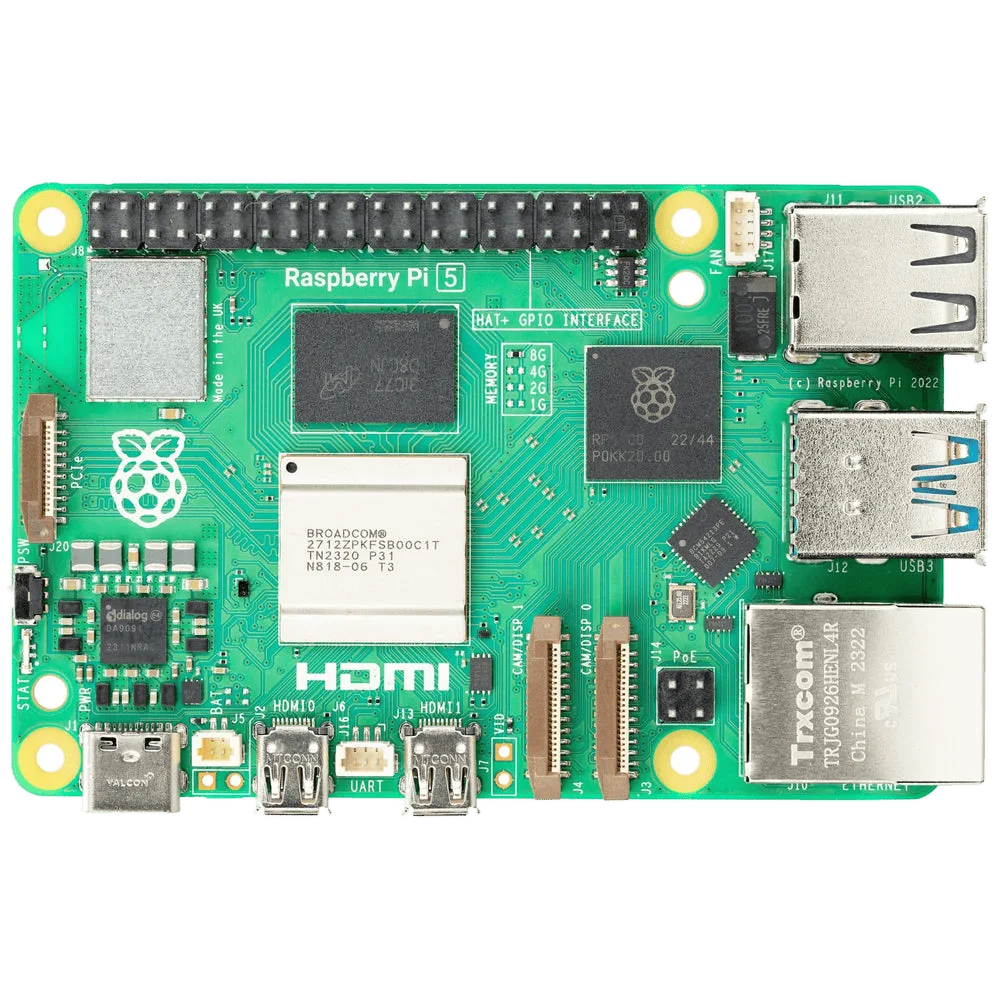
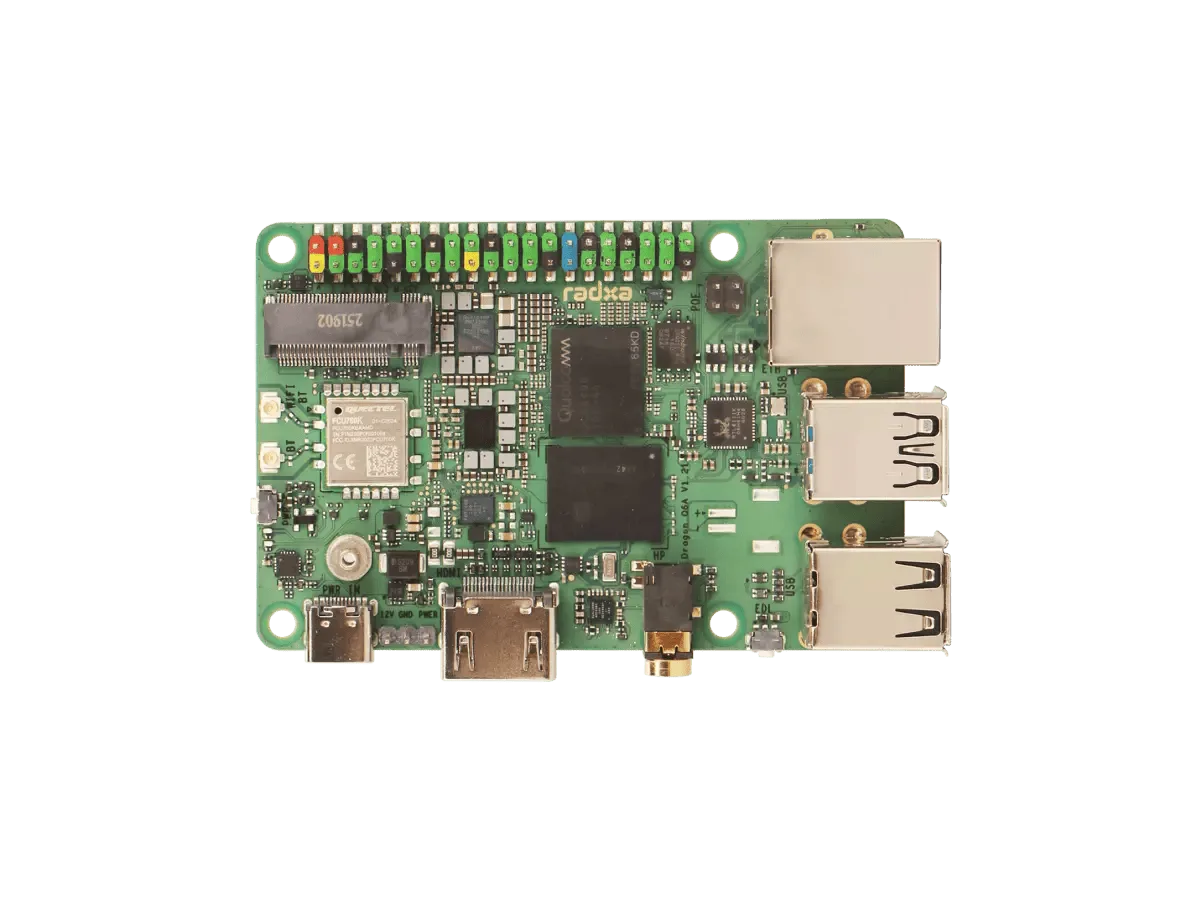
Raspberry Pi 5 vs Radxa Dragon Q6A
Benchmarks, specifications, and real-world performance data
Tested by Bret Weber Last updated
Fastest
Radxa Dragon Q6A
3,215 GB6 multi-core
Best value
Radxa Dragon Q6A
28.0 GB6 pts/$ at $115
Most efficient
Radxa Dragon Q6A
6.4W under load
Expert Summary
The Dragon Q6A uses a Qualcomm QCS6490 and has a 12 TOPS NPU built in. That's a lot of AI horsepower without needing an external HAT. It also supports UFS 3.1, eMMC, and NVMe (PCIe Gen3 x2), so you have more storage options than the Pi 5's microSD or single PCIe Gen2 (or 3 if you force it) lane.
Where the Q6A struggles is software. The Pi 5 has years of polish and community support, which matters if you're using it as a desktop or general-purpose machine. The Dragon Q6A makes sense for edge AI or robotics projects where you need that NPU and faster wireless (Wi-Fi 6, Bluetooth 5.4). Otherwise, the Pi 5 is easier to work with.
Read our individual reviews:
Multiple benchmark runs available. Perfect for seeing how different OS versions, kernels, and carrier boards may impact performance numbers. For example, Raspberry Pi OS vs Ubuntu on the Raspberry Pi 5, or official vs third-party carrier boards for your CM5.


Every figure above comes from hardware run in-house by Bret Weber, on the exact OS build, kernel, firmware and boot device listed here. Boards are tested to a fixed procedure so results stay comparable between them: see our testing methodology for how each benchmark is run.
Detailed Reviews
Read our comprehensive reviews from bret.dk featuring data and benchmarks from sbc.compare:

CPU Performance
Processor performance across single and multi-core workloads
Geekbench 6
Higher Scores are Better
7-Zip Benchmark
Higher Scores are Better
High Performance Linpack
Higher Scores are Better
UnixBench
Higher Scores are Better
PassMark CPU
Higher Scores are Better
CPU Mining (cpuminer-multi)
Higher Hashrates are Better
Memory Performance
Memory bandwidth and throughput benchmarks
PassMark RAM
Higher Scores are Better
GPU Performance
Graphics rendering with OpenGL and Vulkan, plus raw Vulkan compute throughput
glmark2 (OpenGL)
Higher Scores are Better
Only this board has been tested so far, so there is nothing to compare against yet.
vkmark (Vulkan)
Higher Scores are Better
Only this board has been tested so far, so there is nothing to compare against yet.
AI & LLM Performance
Large Language Model inference performance
Ollama LLM Benchmark
Higher Scores are Better
Storage Performance
Disk I/O throughput measured with FIO
fio Storage Performance - microSD
Higher Speeds are Better • Raspberry Pi 64GB (64GB microSD)
fio Storage Performance - M.2 NVMe
Higher Speeds are Better • Crucial P5 Plus (1024GB M.2 NVMe)
fio Storage Performance - UFS
Higher Speeds are Better • Radxa UFS (128GB UFS)
Only this board has been tested so far, so there is nothing to compare against yet.
Network Performance
Ethernet and WiFi throughput measured with iPerf3
iPerf3 Network Performance
Higher Speeds are Better
Power & Thermal
Power consumption at idle and under various workloads
Power Consumption
Lower is "Better"
Cooling & Thermal Testing
Frequently Asked Questions
Which is faster, the Radxa Dragon Q6A or the Raspberry Pi 5?
The Radxa Dragon Q6A is faster in our testing, scoring 3,215 in Geekbench 6 multi-core versus 2,188 for the Raspberry Pi 5, a 47% advantage.
Which board is the best value?
Of the boards in this comparison, the Radxa Dragon Q6A offers the best performance per dollar: 28.0 Geekbench 6 multi-core points per dollar at $115.00.
Add One More Board
You can compare up to 3 boards at once. Add one more to get the complete comparison.