
Orange Pi AI Station Launches with Ascend 310 and 176 TOPS Performance
Orange Pi expands on its position in the AI computing space with the AI Station, featuring Huawei's Ascend 310 processor delivering 176 TOPS across 16 CPU cores and 10 AI cores.
Orange Pi has closed out 2025 with details on the Orange Pi AI Station, a 130x130mm edge AI platform built around Huawei's Ascend 310 series processor. With 176 TOPS of claimed AI compute performance and memory configurations up to 96GB, this sits between their earlier AI Pro 8T SBC and the AI Studio boxes in their expanding Ascend-based lineup.
Orange Pi's AI Product Expansion#
This marks Orange Pi's third Ascend-based product in under a year (if you count the introduction of the AI Pro 8T to a non-Chinese market at the beginning of the year as a new launch) followed by the AI Studio and AI Studio Pro USB4 boxes in September offering 176 and 352 TOPS respectively. The AI Station slots in between these, matching the AI Studio's 176 TOPS while keeping the board-level format factor.
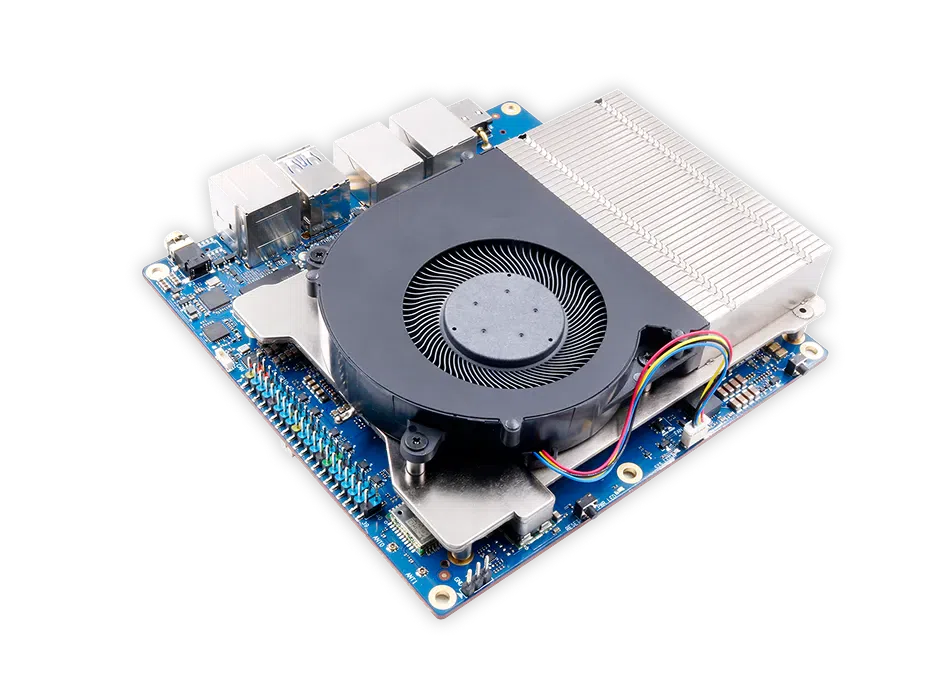
The form factor is a 130x130mm square board, larger than typical SBCs, and it ships with what appears to be the same heatsink and fan combination used on the Orange Pi 6 Plus, which makes sense given the thermal requirements of the Ascend 310.
What We're Looking At#
At the heart of the board is Huawei's Ascend 310 series chip, bringing 16 general-purpose cores (maxing out at 1.9GHz) alongside dedicated AI hardware in the form of 10 cores for AI workloads and 8 vector processing cores. The 176 TOPS marketing number sounds impressive, though what you'll actually get depends on your models and how well the Ascend toolchain supports them.
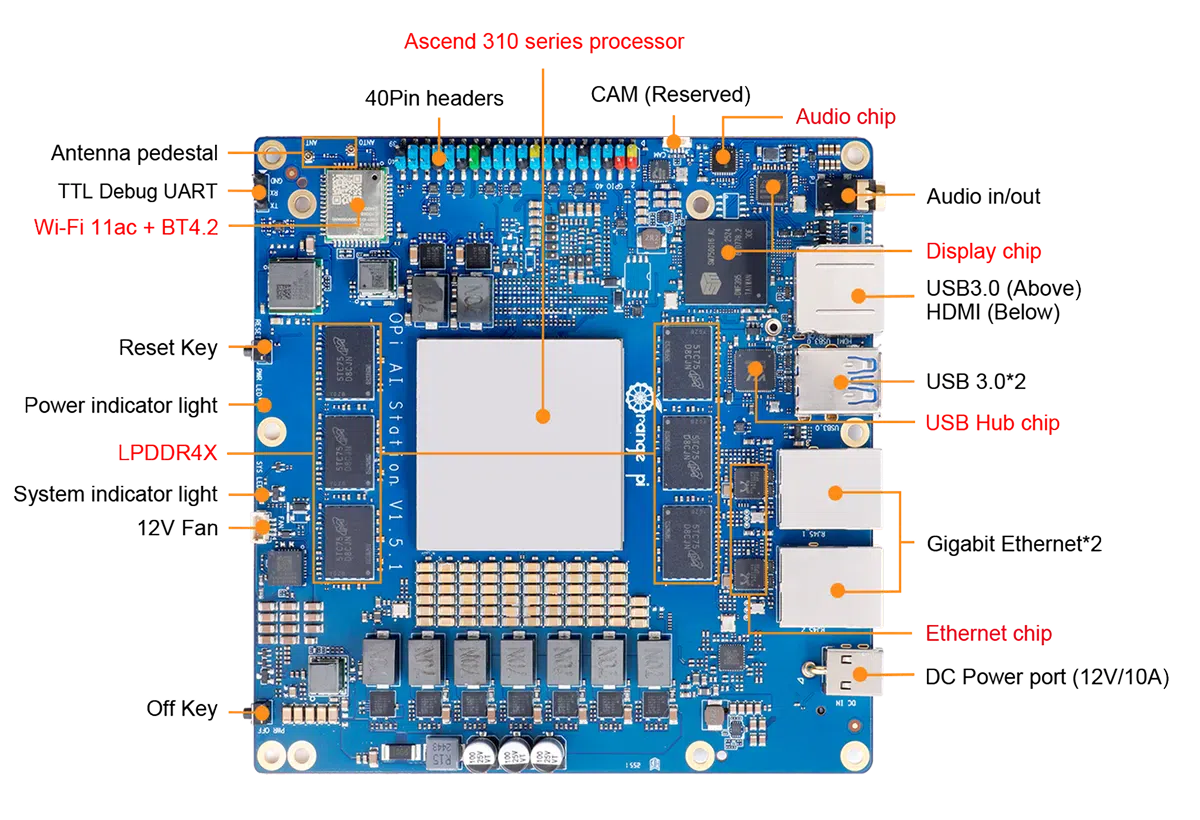
On the memory side, you're looking at either 48GB or 96GB of LPDDR4X. That's proper capacity for running larger models locally. Storage options are the usual spread. Tehere's an M.2 slot taking 2280 NVMe drives over PCIe 4.0 x4, eMMC support if you want onboard storage up to 256GB, a microSD card reader (data only, won't boot), and 16MB of SPI flash for the bootloader.
Connectivity and I/O#
Networking is handled by dual Gigabit Ethernet ports and built-in Wi-Fi 5 with Bluetooth 4.2. The wireless is single-stream 802.11ac, so it's not going to set any speed records, but it covers the bases.
For peripherals, there are three USB 3.0 Type-A ports. Orange Pi specs these at 1A current limiting, so keep that in mind if you're planning to power hungry devices. Video output goes through a single HDMI port capped at 1080p60, which is fine given this isn't really aimed at desktop use. Audio gets a 3.5mm jack.
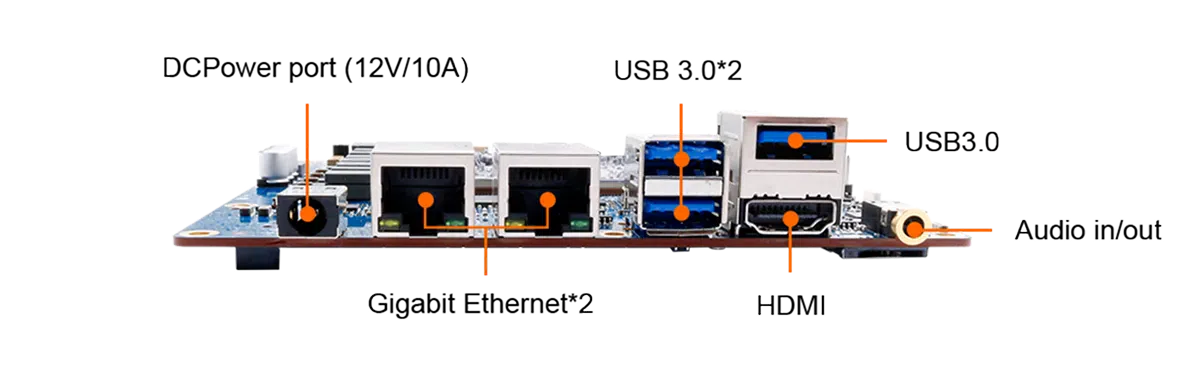
The 40-pin header brings out GPIO along with I2C, SPI, PWM, and UART if you need to interface with other hardware. There's a fan header for the included active cooler, power and reset buttons, and the typical status LEDs. Power comes in via a 5.5mm barrel jack at 12V/10A, with the adapter included.
Software Support and Ecosystem#
The official OS is openEuler 22.03, and Orange Pi says it'll run common open-source LLMs like the DeepSeek and Llama families. Whether that actually works smoothly is another question as the Ascend ecosystem doesn't have the polish of NVIDIA's CUDA stack or even the newer Hailo tools.
Right now the Downloads section on Orange Pi's product page is empty so we have no clues there, however it’s not unusual for a new Orange Pi product announcement. It does mean early buyers will be sitting around waiting for software before they can do anything useful.
If you're considering this board, check whether your specific use case and models have good Ascend support first. The hardware looks capable enough, but software maturity is going to determine whether this is actually usable for your workload.
What Makes This Interesting#
The AI Station fills a gap in Orange Pi's lineup between the more compact AI Pro 8T and the bulkier AI Studio boxes. If you want serious compute (176 TOPS) but don't need the dual-chip setup of the AI Studio Pro, this gives you a board-level option with standard mounting holes and GPIO access.
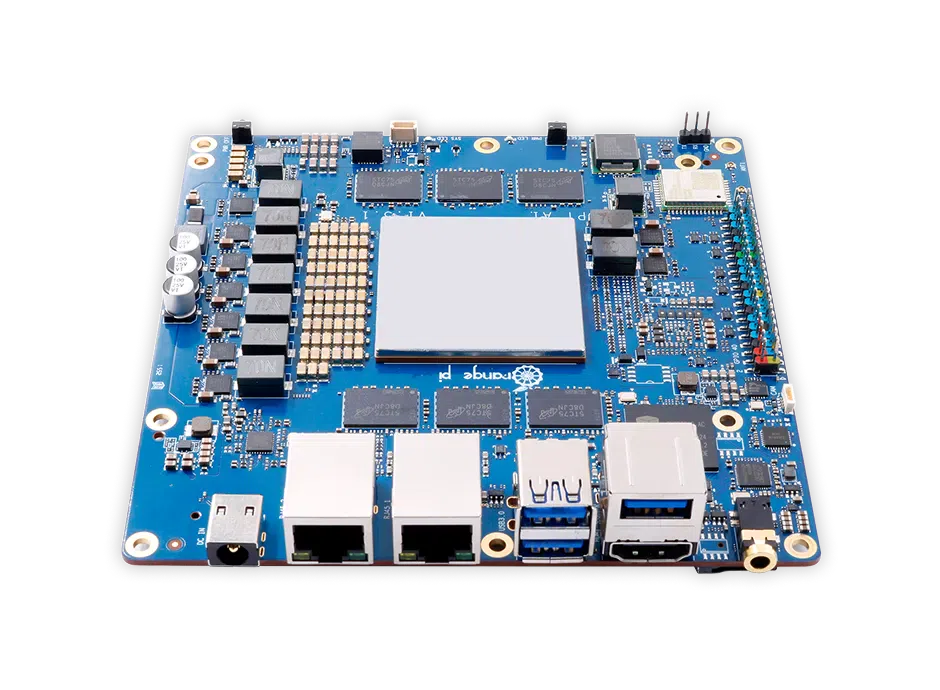
The dual Gigabit Ethernet setup opens up some interesting use cases too, whether that's handling multiple camera streams for computer vision applications or acting as a network appliance with AI processing capabilities.
Pricing hasn't been announced yet, and Orange Pi's usual sales channels (AliExpress and Amazon) don't have listings up at the moment. The AI Studio starts around $955 for 48GB RAM, so expect the AI Station to undercut that given it's a single-chip board without the USB4 enclosure. Where it lands relative to the AI Pro 8T (which starts much lower) will determine whether this makes sense for most buyers.
My Thoughts#
Orange Pi has moved quickly on Ascend hardware this year, going from the AI Pro 8T to the AI Studio boxes and now this AI Station in under 12 months. That's a lot of SKUs to support, and it'll be interesting to see if they can keep the software side updated across all of them.
The AI Station makes sense as a product. There's clearly a gap between an 8 TOPS SBC and a $1900+ dual-chip box. Whether the market exists for a 176 TOPS board-level option at whatever price Orange Pi lands on remains to be seen.
For those already invested in Huawei's AI ecosystem or looking to experiment with alternatives to NVIDIA's platform, this adds another option to consider. For everyone else, it might be worth waiting to see how software support develops across Orange Pi's growing Ascend lineup and what the actual pricing looks like.
I won't be rushing out to test one of these immediately, but if the software situation improves and the pricing is reasonable, it could be an interesting option for specific AI inference workloads. As always, hardware is only half the story.
More information is available on the Orange Pi AI Station product page, though in-depth documentation is still pending.

SBC benchmarking specialist with 5+ years of dedicated testing experience. Tested over 100 single board computers to provide accurate, real-world performance data.
View all articles by Bret Weber →