
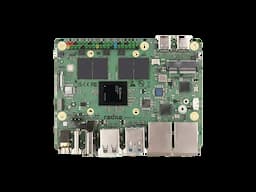
Radxa Dragon Q8B
Benchmarks, specifications, and real-world performance data
Tested by Bret Weber Last updated
Tested Setups
We benchmarked this board in 3 setups. Every score on this page follows the one selected.
Geekbench 6
7,058
multi-core · 1,683 single-core
Power draw
25.1W load
5.9W idle
Peak temp
51°C
stock cooling, sustained load
Price
$676.99
Expert Summary
The Radxa Dragon Q8B is essentially a laptop operating in an SBC form factor. The Qualcomm Snapdragon 8cx Gen 3 System-on-Chip (SoC) is running 4 Cortex-X1 cores at 3GHz, and a further 4 Cortex-A78 cores running at 2.5GHz. At the time of testing (in May 2026), it was the fastest single board computer to go through our test benches. Will it retain its throne?
| Specification | Radxa Dragon Q8B 32GB RAM |
|---|---|
| Basic Specifications | |
| Price | $676.99 |
| RAM | 32GB |
| SoC | |
| Architecture | ARM |
| CPU Cores | 8 cores 4× Cortex-X1 @ 3.0GHz 4× Cortex-A78 @ 2.4GHz |
Price History
$676.99 at Allnet China, unchanged since 2 October 2026. Checked daily.
- Official store · Allnet China$676.99 Out of stock
Every figure above comes from hardware run in-house by Bret Weber, on the exact OS build, kernel, firmware and boot device listed here. Boards are tested to a fixed procedure so results stay comparable between them: see our testing methodology for how each benchmark is run.

CPU Performance
Processor performance across single and multi-core workloads
Geekbench 6
Higher Scores are Better
Geekbench 7
Higher Scores are Better
7-Zip Benchmark
Higher Scores are Better
High Performance Linpack
Higher Scores are Better
UnixBench
Higher Scores are Better
Memory Performance
Memory bandwidth and throughput benchmarks
GPU Performance
Graphics rendering with OpenGL and Vulkan, plus raw Vulkan compute throughput
glmark2 (OpenGL)
Higher Scores are Better
vkmark (Vulkan)
Higher Scores are Better
SuperTuxKart (Gaming)
Higher FPS is Better
AI & LLM Performance
Large Language Model inference performance
Ollama LLM Benchmark
Higher Scores are Better
Storage Performance
Disk I/O throughput measured with FIO
fio Storage Performance - microSD
Higher Speeds are Better • Raspberry Pi 64GB (64GB microSD)
fio Storage Performance - M.2 NVMe
Higher Speeds are Better • Crucial P5 Plus (1024GB M.2 NVMe)
fio Storage Performance - UFS
Higher Speeds are Better • Radxa UFS (128GB UFS)
Network Performance
Ethernet and WiFi throughput measured with iPerf3
iPerf3 Network Performance
Higher Speeds are Better
Power & Thermal
Power consumption at idle and under various workloads
Power Consumption
Lower is "Better"
Cooling & Thermal Testing
Frequently Asked Questions
How fast is the Radxa Dragon Q8B?
In our testing the Radxa Dragon Q8B scored 7,058 in Geekbench 6 multi-core and 1,683 in single-core, with 36,243 MIPS in multi-core 7-Zip compression.
How much power does the Radxa Dragon Q8B use?
We measured the Radxa Dragon Q8B drawing 5.9W at idle and 25.1W under sustained CPU load.
How much does the Radxa Dragon Q8B cost?
The Radxa Dragon Q8B sells for $676.99 at the official store (Allnet China) as of 14 October 2026 for the 32GB RAM configuration, although it was out of stock at the last check. The price has not changed since we began tracking it on 2 October 2026. Prices are in USD before tax and shipping.
See how the Radxa Dragon Q8B stacks up against another board, side by side.